
[[{“value”:”
Tamil Nadu’s CM M.K. Stalin today (October 9) launched Inc42’s The State Of Tamil Nadu Startup Ecosystem Report 2025 at Global Startup Summit 2025, which captures the rise of the state as a global hub of startup innovation and intellectual capital.
“Today, we have released Inc42’s research report on Tamil Nadu’s startup ecosystem, showcasing the remarkable growth of the state from about 2,000 to over 12,000 startups in just four years. Tamil Nadu is transforming from a manufacturing powerhouse into a global innovation hub,” said CM M.K. Stalin.
Tamil Nadu Global Startup Summit (TNGSS) 2025, organised by StartupTN at Coimbatore’s Codissia Trade Fair Complex, saw a host of global leaders sharing the stage with Tamil Nadu’s very own entrepreneurs.
The state’s rapid growth in the startup ecosystem over the past four years has positioned it as one of Asia’s leading startup hubs. This has also been supported by a widespread network of incubation centres, which are fostering startups across sectors such as spacetech, SaaS, fintech, deeptech, renewable energy, and semiconductors — attracting both domestic and international investors.
With the government’s support, favourable policies, and access to skilled talent from premier institutions, the state is not only nurturing early stage startups but also scaling them into globally competitive companies.
The Tamil Nadu Startup Ecosystem Report, presented as a coffee table book at TNGSS 2025, captures the beating heart of Tamil Nadu’s startup ecosystem and celebrates the remarkable journey of turning entrepreneurial talent into successful, future-ready businesses.
Key Insights From The State Of Tamil Nadu Startup Ecosystem Report 2025
The Economic Might Of Tamil Nadu
Tamil Nadu is India’s second-largest state economy, with a gross state domestic product (GSDP) of over $369 Bn in FY25. It recorded real GSDP growth of 11.19% in 2024–25, the highest among all Indian states. The state ranks first in the country by number of factories and serves as a key manufacturing centre, accounting for 40% of India’s smartphone exports.
Tamil Nadu’s GDP per capita stood at $4.1K in FY25, the second-highest in India. Looking ahead, the state government aims to increase the number of DPIIT-registered startups to 1 Lakh and reach a $1 Tn economy by 2030.
The State Of Funding
Tamil Nadu’s startup ecosystem continues to attract capital across all stages, with particular strength in B2B and software-as-a-service (SaaS) ventures. Since 2016, startups from the state have raised more than $4.2 Bn in venture funding.

The state has also emerged as India’s third-largest deeptech hub, with startups in sectors such as space, defence and hardware, collectively securing over $184 Mn. Funding for Chennai-based deeptech startups has grown at a three-year compound annual growth rate (CAGR) of 66%.
At the early stage, the ecosystem remains active, with startups raising over $183 Mn and a median ticket size of $810K, supported by more than 360 unique investors. Growth stage companies have together raised about $1.3 Bn across 112 deals, marking the depth and diversity of the state’s broader investment outlook.
Inclusivity And Talent
Tamil Nadu is setting a national benchmark for equitable entrepreneurship, supported by a large and skilled talent pool. About 50.1% of the state’s DPIIT-registered startups, around 6,016 ventures, are led by women, a proportion seen nowhere else in India. Venture capital investments in women-led startups have also grown at a compound annual growth rate (CAGR) of 29% between 2019 and 2024.
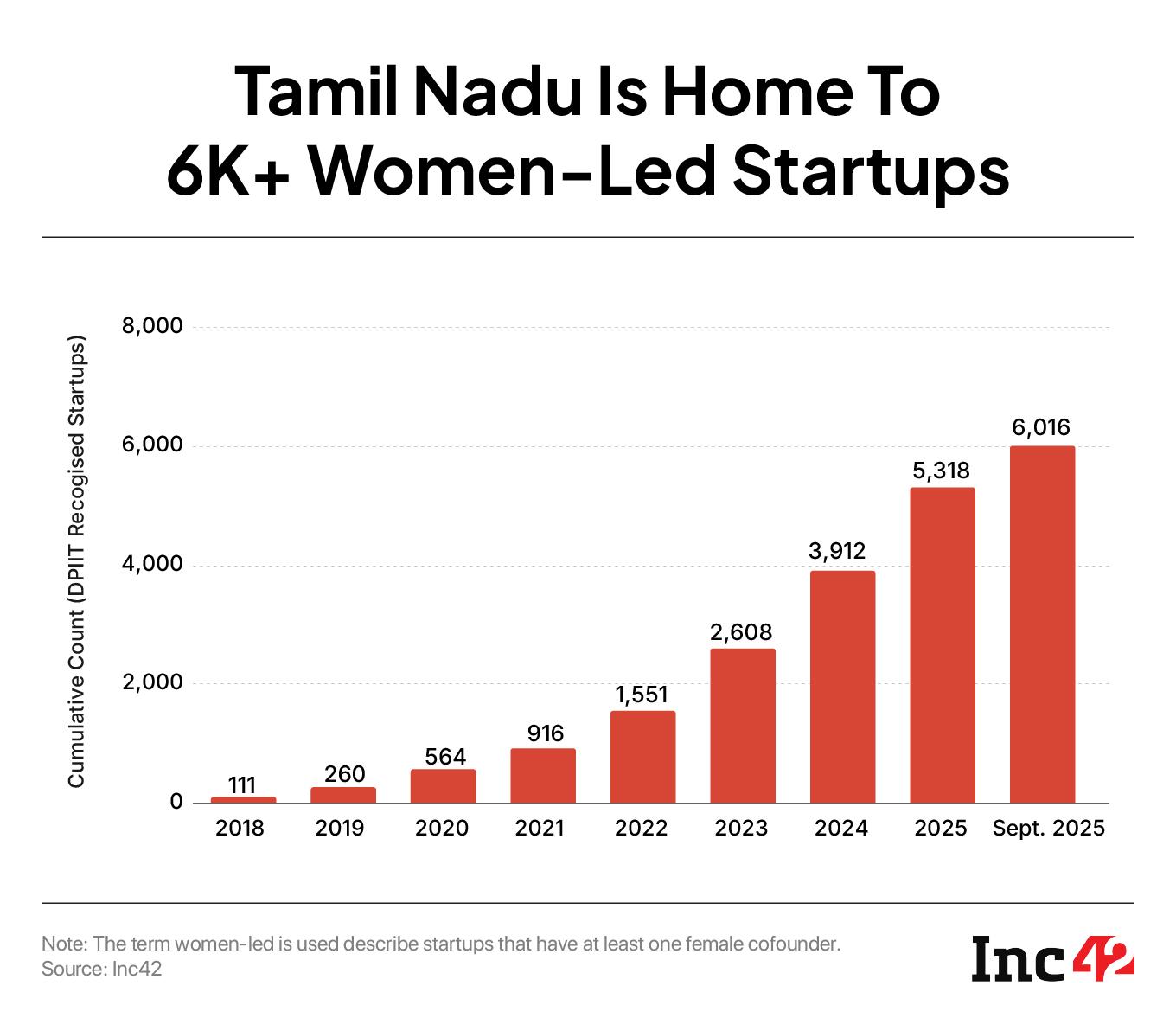
This talent pipeline is sustained by the state’s education system, with over 525 active engineering colleges producing nearly 2 Lakh engineering graduates each year. Tamil Nadu also records a literacy rate of 80%, which reinforces its human capital advantage.
Tamil Nadu’s Infrastructure Advantage
Tamil Nadu is the fourth-largest exporter of information technology (IT) services in India, with exports exceeding $9.7 Bn in FY24. The state also accounts for 40% of India’s smartphone exports.
The state’s sectoral leadership is supported by a cluster of enabling infrastructure, such as the development of 120 incubation centres across all 38 districts. Thanks to better connectivity, access, and aligned policies, centres such as Salem, Trichy and Vellore are recording steady expansion.
What Is Fuelling Tamil Nadu’s Startup Ecosystem?
From just over 2,000 DPIIT-registered startups in 2021, Tamil Nadu’s startup ecosystem has grown to more than 12,000 today. More than half of these ventures are led by women.
The value of the state’s startup economy has also grown manifold — from a mere $3 Bn in 2021 to $27.4 Bn in 2024. This has earned the state the title of ‘Best Performer’ in the Government of India’s ‘States’ Startup Ranking’.
Driving this growth are the policies of the government and on-ground execution through an initiative named Tamil Nadu Startup and Innovation Mission (TANSIM or StartupTN). Since 2021, StartupTN has helped ideas turn into functioning ventures and then into sustainable businesses.
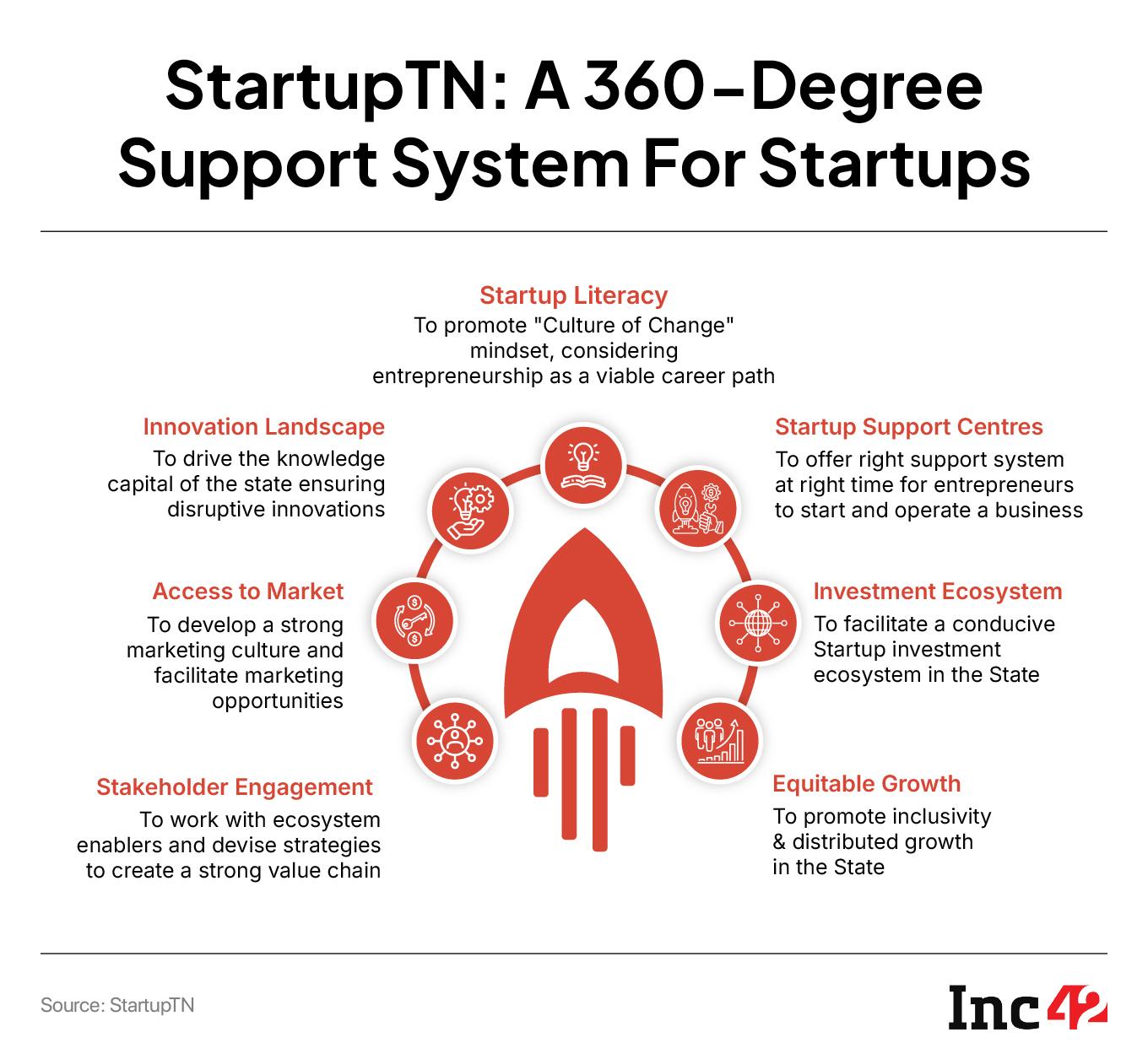
The initiative has expanded Tamil Nadu’s incubation network to 120 centres across 10 regional hubs, launched the Tamil Nadu Startup Seed Fund (TANSEED), and actively encourages patent and trademark registrations by subsidising costs by covering 75% of the patent registration fee and 50% of the trademark registration fee.
StartupTN has also conducted women-focussed startup bootcamps, established the Tamil Nadu SC/ST Fund to widen participation across communities, and allocated dedicated funding for startups addressing rural livelihood challenges.
In TN Becoming The World’s Next Startup Playground
According to The State Of Tamil Nadu Startup Ecosystem Report, if Tamil Nadu sustains its current pace, its ‘Vision 2032’ to rank among the world’s top 20 startup destinations seems well within reach. But the next leap lies in democratising innovation beyond Chennai through targeted funding, infrastructure expansion, and market access support for emerging regional hubs.
The state’s network of StartupTN regional centres marks an encouraging start, but achieving true decentralisation will demand deeper capital infusion and ecosystem-level collaboration.
The report also suggests that strengthening global market connectivity will play a crucial role in Tamil Nadu’s ambition to establish itself on the global stage. By building international partnerships, enabling cross-border programmes, and embedding its startups within global value chains, Tamil Nadu can evolve from a regional innovation hub into a global launchpad for new ventures.
While the state’s strong manufacturing base offers a natural edge, especially in hardware and deeptech, sustained policy and governance will play a crucial role in the ecosystem’s growth.
The post CM M.K. Stalin Unveils Inc42’s The State Of Tamil Nadu Startup Ecosystem Report 2025 appeared first on Inc42 Media.
“}]]
Read More Latest Startup News From The Indian Startup Ecosystem – Inc42 Media